
First hours: the tick into a container, yourself to a doctor
Remove the tick carefully with tweezers or a special loop without crushing it, and treat the bite site with an antiseptic. Put the tick in a clean jar with damp cotton wool or tissue and take it within 1–2 days to a laboratory that tests ticks (in Russia these are hygiene and epidemiology centres and private laboratories; in many other countries tick testing is not routinely offered — ask your doctor or public health service).
If the bite happened in an area endemic for tick-borne encephalitis and the person is not vaccinated, see a doctor right away: in Russia emergency prophylaxis with immunoglobulin is used, and it is effective within the first 96 hours.
Testing the tick: the fastest answer
PCR is used to look in the tick for tick-borne encephalitis virus, Borrelia (the cause of Lyme disease) and, in extended panels, Anaplasma and Ehrlichia. The result is usually ready in 1–2 days.
A negative result is reassuring, but not 100 %: the person may have been bitten by another, unnoticed tick. A positive one is a reason to consult an infectious disease specialist, not to self-treat: infection from an infected tick does not always happen.
Blood: why timing matters
Antibodies do not appear right away. IgM to tick-borne encephalitis virus is usually detectable 10–14 days after the bite, by the time symptoms start. IgM to Borrelia — after 3–6 weeks, IgG later. A blood test the day after the bite only shows what was there before it.
If the tick was not tested, a typical scheme is blood antibodies to tick-borne encephalitis after 10–14 days and to Borrelia after 3–6 weeks; the doctor sets the exact timing and set of tests. Blood PCR for the virus is sometimes used in the first days if fever appears.
Lyme disease: a diagnosis made on the skin
Erythema migrans — an expanding red patch of 5 cm or more at the bite site 3–30 days later — is a clinical diagnosis of Lyme borreliosis, and treatment starts without waiting for tests: in the first weeks antibodies are often still negative.
For confirmation at later stages a two-step scheme is used: an ELISA, and if it is positive or equivocal, an immunoblot (Western blot).
Warning signs
Fever, headache, weakness, nausea and muscle aches within a month after the bite are a reason to see a doctor right away and mention the tick. Do not wait for the "proper time for the test" if symptoms have appeared.
Timing of tests after a tick bite
- The tick — to a laboratory within 1–2 days (PCR)
- A doctor — within 96 hours if the area is endemic and you are not vaccinated
- IgM to tick-borne encephalitis — after 10–14 days
- Antibodies to Borrelia — after 3–6 weeks
- Erythema migrans — treatment without waiting for tests
Several markers on your report?
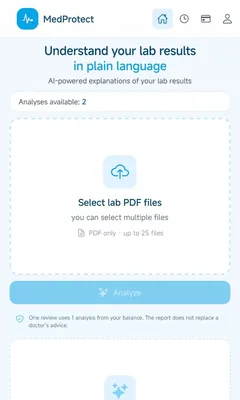
See how MedProtect explains results in the app: the whole report, a check of the recognized values, and a clear breakdown.
- Your whole lab report explained in plain language
- A health record: every test by date in one place
- Trends over time and questions for your doctor
- Only anonymised values go to the AI
Tick bite: frequently asked questions
Can I test my blood for encephalitis right after the bite?
The tick tested negative — can I skip the blood test?
I am vaccinated against tick-borne encephalitis — do I need any tests?
I threw the tick away — what now?
Sources
- Tick-borne encephalitis: fact sheet — World Health Organization. Accessed: October 21, 2026.
- Lyme Disease Tests: MedlinePlus Medical Test — MedlinePlus, National Library of Medicine. Accessed: October 21, 2026.