
Why measles antibodies are tested
Measles is one of the most contagious infections, and protection from a vaccine given decades ago does not last in everyone. IgG is tested when there are no records of two vaccine doses, when planning a pregnancy, before travel to countries with outbreaks, in health and education workers, and after contact with a sick person to decide whether an emergency vaccine dose is needed.
IgG: how to read the result
IgG are "memory antibodies". Their amount is expressed in international units (IU/mL), and each test kit has its own cut-offs for "negative", "equivocal (grey zone)" and "positive" — they are shown on the report. Use only those.
A positive result means protective antibodies are present. A negative or equivocal one means protection may be insufficient: the doctor decides about vaccination. There is usually no medical contraindication to revaccinating a person who has antibodies — so when in doubt, vaccination is chosen.
IgM: diagnosing acute measles
IgM appears in acute illness — usually by days 3–4 of the rash. It is tested when measles is suspected: fever, cough, runny nose, conjunctivitis, then a rash spreading from top to bottom. In this case do not go to the laboratory yourself — call the doctor to your home or phone ahead: measles is airborne.
PCR (nasopharyngeal swab, urine) is also used for confirmation. Testing IgM "to check immunity" makes no sense.
Test or vaccinate straight away
If vaccination records are lost and there is a risk of infection, it is often easier and cheaper for an adult to get vaccinated than to be tested first: an extra dose is safe for most people. The adult vaccination schedule is set by the national immunization programme — check it with your clinic.
Women planning a pregnancy should know in advance: live measles and rubella vaccines are not given during pregnancy, and after vaccination it is advised to postpone conception for a period the doctor will specify.
Rubella and mumps
Immunity to rubella (especially before pregnancy: the infection is dangerous for the fetus) and to mumps is checked in the same way. For rubella an IgG level of 10 IU/mL or more is often considered protective, but the cut-off depends on the test kit and is shown on the report.
Measles: which test for which task
- To check protection — measles IgG
- Suspected acute measles — IgM and PCR, call the doctor
- Equivocal or negative IgG — discuss vaccination
- No vaccination records — often easier to get vaccinated
- Before pregnancy — measles and rubella IgG in advance
Several markers on your report?
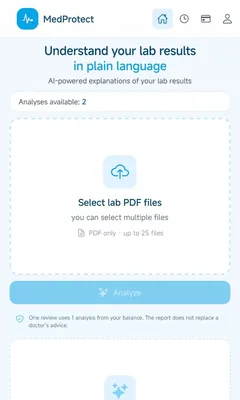
See how MedProtect explains results in the app: the whole report, a check of the recognized values, and a clear breakdown.
- Your whole lab report explained in plain language
- A health record: every test by date in one place
- Trends over time and questions for your doctor
- Only anonymised values go to the AI
Measles test: frequently asked questions
Measles antibodies are negative although I was vaccinated — is that possible?
The result is "equivocal" — what should I do?
Does a child need a test before the measles vaccine?
Can I test measles antibodies after vaccination to check it worked?
Sources
- Measles: fact sheet — World Health Organization. Accessed: October 21, 2026.
- Measles and Mumps Tests: MedlinePlus Medical Test — MedlinePlus, National Library of Medicine. Accessed: October 21, 2026.