
Troponin: a marker of heart muscle damage
Troponins I and T are proteins of the contractile apparatus of heart muscle cells. A healthy person has almost none in the blood; when heart muscle is damaged, they leak into the blood within a few hours. Modern high-sensitivity tests detect very small amounts, so the result is read against the 99th percentile of healthy people, which is shown on the laboratory report.
The key word is trend. A single value says little: the doctor compares the first measurement with a second one 1–3 hours later (according to the hospital protocol). A rise with typical pain and ECG changes means a heart attack; a stable raised level without a rise is seen in chronic heart and kidney disease.
Why troponin can be high without a heart attack
Troponin reflects any damage to the heart muscle: myocarditis, severe strain on the heart in pneumonia and sepsis, pulmonary embolism, arrhythmias, chronic kidney disease, ultra-long marathons. So a raised troponin is not a synonym for a heart attack, but it always needs assessment by a doctor.
Testing troponin "for prevention" in a commercial laboratory makes no sense: without symptoms it replaces neither an ECG nor an assessment of risk factors, and a normal value without pain promises nothing about the future.
CK-MB and myoglobin: some history
Before troponins, a heart attack was confirmed with CK-MB and myoglobin. Both are less specific: they also rise with skeletal muscle damage. Today they are rarely used — for example, CK-MB sometimes helps assess repeat damage in the first days after a heart attack. If total CK is raised on a report without chest pain, the cause is almost always muscle.
NT-proBNP and BNP: markers of strain on the heart
Natriuretic peptides are released by the walls of the ventricles when they are stretched by pressure or blood volume. The main strength of the test is ruling out: in a person with shortness of breath, a normal NT-proBNP makes heart failure unlikely. In European guidelines the rule-out thresholds are about 125 pg/mL outside an acute situation and 300 pg/mL with sudden shortness of breath.
The level rises with age, in kidney disease and atrial fibrillation, and in obesity it may be lower than expected. So a raised NT-proBNP is a reason for an echocardiogram and a cardiology visit, not a diagnosis on its own.
What to do with the results
Pain or pressure in the chest spreading to the arm, jaw or back, shortness of breath, a cold sweat — this is not a reason to go to a laboratory. Call emergency services: the time until the artery is opened decides the outcome of a heart attack.
If a raised troponin or NT-proBNP was found on a routine test while you feel well, take the result to a cardiologist in the next few days, together with an ECG and data on blood pressure, creatinine and hemoglobin.
Heart markers in one list
- Troponin I/T — myocardial damage, read as a trend
- CK-MB — outdated marker, less specific
- NT-proBNP / BNP — strain on the heart, best at ruling out heart failure
- Creatinine — the kidneys affect troponin and NT-proBNP
- Chest pain — call emergency services, do not get tests
Several markers on your report?
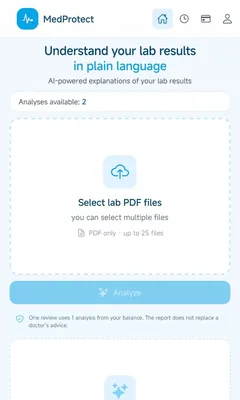
See how MedProtect explains results in the app: the whole report, a check of the recognized values, and a clear breakdown.
- Your whole lab report explained in plain language
- A health record: every test by date in one place
- Trends over time and questions for your doctor
- Only anonymised values go to the AI
Troponin, CK-MB and NT-proBNP: frequently asked questions
Can I test troponin at an ordinary laboratory if my heart hurts?
Troponin is slightly above normal, but my heart does not hurt — what is it?
NT-proBNP is normal — does that mean there is no heart failure?
Why test CK-MB if there is troponin?
Sources
- Troponin Test: MedlinePlus Medical Test — MedlinePlus, National Library of Medicine. Accessed: October 21, 2026.
- Natriuretic Peptide Tests (BNP, NT-proBNP): MedlinePlus Medical Test — MedlinePlus, National Library of Medicine. Accessed: October 21, 2026.
- Creatine Kinase: MedlinePlus Medical Test — MedlinePlus, National Library of Medicine. Accessed: October 21, 2026.