
When fatigue is a symptom, not a lifestyle
Tiredness after a hard week is normal; fatigue that does not lift for a month and is not fixed by sleep or vacation is a symptom. Before blaming age and "that's life," check the reversible causes — and nearly all of them are laboratory ones.
The logic is simple: the most frequent culprits — iron deficiency, hypothyroidism, low vitamin D, hidden diabetes, and smoldering inflammation — are visible in ordinary, inexpensive tests. Start there.
Iron and thyroid: the two prime suspects
Hidden iron deficiency is the champion cause of fatigue in women: hemoglobin is still normal while ferritin is already at the bottom. So a blood count without ferritin is half the picture — test the pair, or early-stage deficiency walks past unnoticed.
Hypothyroidism is the second champion: a slowed metabolism brings sleepiness, chilliness, swelling, and a "cotton-wool" head. A single TSH line answers that question; if it deviates, the doctor adds free T4 and TPO antibodies.
Vitamins, sugar, and inflammation
Vitamin D and B12 deficiencies can be associated with low energy and difficulty concentrating. Vitamin D status cannot be judged from the season or region alone: when deficiency is suspected, it is checked with a blood test. If deficiency is confirmed, the clinician determines the next steps; otherwise, the search for the cause continues.
Fasting glucose helps detect abnormalities, but one normal result does not rule out diabetes. When diabetes is suspected, the clinician may also consider A1C and other tests. CRP helps assess inflammation. Do not test cortisol without a doctor’s order: its level depends on the time of day and stress, and a random number can confuse.
If the tests are clean
A clean basic set is also a result: it shifts the search to non-chemical causes. First candidate — sleep apnea: snoring, witnessed pauses in breathing, and daytime sleepiness point to a sleep specialist, not a laboratory.
Next — depression and anxiety, which disguise themselves as physical fatigue, the aftermath of past infections, and a plain lack of movement: paradoxically, a sitting life tires more. A limited basic panel helps narrow the search, but it does not exclude every physical cause.
The basic set for fatigue
- Complete blood count plus ferritin — iron and anemia
- TSH — the thyroid
- Vitamin D and B12 — the deficiencies of exhaustion
- Fasting glucose — hidden diabetes
- CRP — hidden inflammation; cortisol — only as ordered
Markers covered in this article
Several markers on your report?
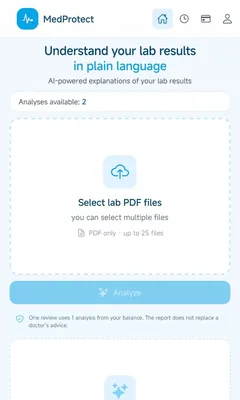
See how MedProtect explains results in the app: the whole report, a check of the recognized values, and a clear breakdown.
- Your whole lab report explained in plain language
- A health record: every test by date in one place
- Trends over time and questions for your doctor
- Only anonymised values go to the AI
Constant fatigue: frequently asked questions
Hemoglobin is normal — can iron be skipped?
Will pharmacy vitamins help without testing?
When is fatigue urgent?
Sources
- Ferritin Blood Test: MedlinePlus Medical Test — MedlinePlus, National Library of Medicine. Accessed: August 29, 2026.
- Ferritin blood test: MedlinePlus Medical Encyclopedia — MedlinePlus, National Library of Medicine. Accessed: August 29, 2026.
- TSH (Thyroid Stimulating Hormone) Test: MedlinePlus Medical Test — MedlinePlus, National Library of Medicine. Accessed: August 29, 2026.
- TSH test: MedlinePlus Medical Encyclopedia — MedlinePlus, National Library of Medicine. Accessed: August 29, 2026.
- The A1C Test & Diabetes — NIDDK — National Institute of Diabetes and Digestive and Kidney Diseases. Accessed: November 1, 2026.